Is your legacy PHP or WordPress application becoming too risky, expensive, or difficult to modernize?
ISHIR helps modernize PHP applications, upgrade WordPress platforms, and integrate AI with experienced PHP developers.

Your PHP application processes transactions, manages customers, supports internal workflows, and keeps your business running. Your WordPress website still generates leads. Your WooCommerce store still accepts orders. Your legacy platform has survived years of business changes, developer transitions, and technology upgrades.
So why modernize something that still works?
Because an application can remain operational long after it becomes expensive, difficult to secure, and increasingly risky to change. What once took your developers two days now takes two weeks. Every PHP upgrade raises compatibility concerns. A simple WordPress plugin update can break critical functionality. Integrating AI-powered automation or a new customer-facing feature requires workarounds that your original architecture was never designed to support.
For business owners and CTOs planning their technology investments for 2027, the question is no longer whether PHP is relevant. The real question is whether your existing PHP architecture can support your next stage of growth without increasing operational risk, technical debt, and development costs.
Legacy PHP modernization is not about abandoning PHP or rebuilding everything with a newer programming language. It is about upgrading outdated runtimes, restructuring fragile code, securing dependencies, improving performance, and introducing modern capabilities without disrupting the business.
An unsupported PHP runtime no longer receives upstream security fixes. That does not automatically mean an application has been compromised, but it increases the burden of identifying vulnerabilities, maintaining compensating controls, and managing security exposure.
Businesses operating older PHP versions may also face compatibility problems with newer libraries, hosting platforms, payment gateways, and third-party services. A PHP version upgrade can become increasingly complicated when the application depends on abandoned packages or undocumented custom functionality.
The solution is a controlled PHP version migration supported by dependency analysis, compatibility testing, and staged deployment. For 2027 planning, organizations should verify the current PHP support schedule and target a version that provides an appropriate security-support window.
Your product team requests a straightforward enhancement. The development team discovers that the feature touches several tightly coupled modules, undocumented database relationships, and code written by developers who left years ago.
What should have been a routine feature becomes an investigation into how the application works. Engineering estimates become unreliable, releases slow down, and business stakeholders begin questioning why seemingly small changes require significant development effort.
Legacy PHP application modernization addresses this by separating business logic, introducing clearer module boundaries, improving automated testing, and refactoring high-change components. The objective is not simply cleaner code. It is faster, safer feature delivery.
WordPress plugins can accelerate development, but an unmanaged plugin ecosystem creates operational complexity. Multiple plugins may introduce overlapping functionality, incompatible dependencies, excessive database queries, and conflicting JavaScript or PHP behavior.
The problem becomes more serious when business-critical workflows depend on abandoned plugins or heavily modified third-party code. A routine update can disrupt forms, checkout functionality, customer portals, or marketing integrations.
WordPress modernization begins with a plugin and theme dependency audit. Businesses should identify which plugins are essential, which can be removed, and which functionality would be better implemented through a maintained custom WordPress plugin or API integration.
When security depends on emergency patches, manual code reviews, and developers remembering undocumented vulnerabilities, the application is operating without a sustainable security process.
Legacy PHP applications may contain insecure database queries, weak authentication logic, outdated cryptographic implementations, exposed credentials, insufficient access controls, or dependencies with known vulnerabilities. WordPress applications can also face risks from outdated plugins, themes, and poorly protected administrative interfaces.
A PHP application security modernization program should include dependency scanning, secure coding reviews, authentication and authorization testing, secrets management, and automated security checks within the deployment pipeline.
A business may need to connect its PHP application with Salesforce, HubSpot, payment providers, ERP platforms, cloud services, or AI-powered customer support tools. Yet its architecture may rely on tightly coupled database operations and server-rendered workflows without stable integration interfaces.
Developers then create direct database connections, duplicate business logic, or build fragile integration scripts. These shortcuts increase maintenance costs and create additional failure points.
Modern PHP development can introduce REST APIs, event-driven integrations, queues, webhooks, and dedicated service boundaries. These capabilities allow businesses to connect existing PHP and WordPress systems with newer technologies without replacing the entire platform.
Slow database queries, excessive synchronous processing, inefficient caching, and poorly managed background jobs can become major bottlenecks as usage grows.
For ecommerce businesses, performance issues can affect product discovery, checkout reliability, and customer experience. For SaaS applications, they can cause slow dashboards, delayed processing, and unpredictable infrastructure costs.
PHP performance modernization should start with profiling and application monitoring. Query optimization, caching, asynchronous processing, and infrastructure improvements should follow measured bottlenecks rather than assumptions about the programming language.
A legacy application often becomes dependent on a small number of people who understand its architecture, customizations, and undocumented business rules.
When those developers leave, take extended leave, or become unavailable, even routine maintenance can become risky. New developers spend weeks understanding the application before they can safely make changes.
A sustainable modernization strategy introduces documentation, automated tests, coding standards, architectural boundaries, and knowledge transfer. Hiring experienced PHP developers can accelerate the process, but the long-term objective should be reducing dependence on individual knowledge.
Your leadership team wants AI-powered customer support, intelligent document processing, automated reporting, semantic search, or workflow automation. Your developers can connect an LLM API, but the application lacks clean access to business data, reliable authorization boundaries, and reusable service interfaces.
Adding AI directly to an already fragile PHP application can create new risks. An AI agent may retrieve sensitive information, perform actions without sufficient authorization, or generate unreliable outputs that affect operational workflows.
AI-ready PHP modernization requires secure APIs, controlled data access, logging, permission checks, and human approval for consequential actions. AI should extend the application’s capabilities without bypassing existing business controls.
The clearest sign of technical debt is not the age of your code. It is the increasing proportion of engineering effort spent keeping existing functionality operational.
When developers repeatedly fix regressions, resolve compatibility issues, investigate outages, and patch brittle integrations, fewer resources remain for features that generate revenue or improve customer experience.
Modernization should reduce this recurring maintenance burden through targeted architectural improvements, better test coverage, supported dependencies, and more reliable deployment processes.
For most businesses, a complete rewrite should not be the default response to legacy PHP problems. The better decision depends on the application’s architecture, business requirements, technical debt, security exposure, and the cost of maintaining existing functionality.
A rewrite may appear attractive because it promises a clean architecture. However, legacy applications often contain years of undocumented business rules, customer-specific workflows, and operational exceptions. Recreating that behavior can take significantly longer than expected.
The right modernization strategy preserves working business capabilities while replacing the components that create measurable risk or prevent growth.
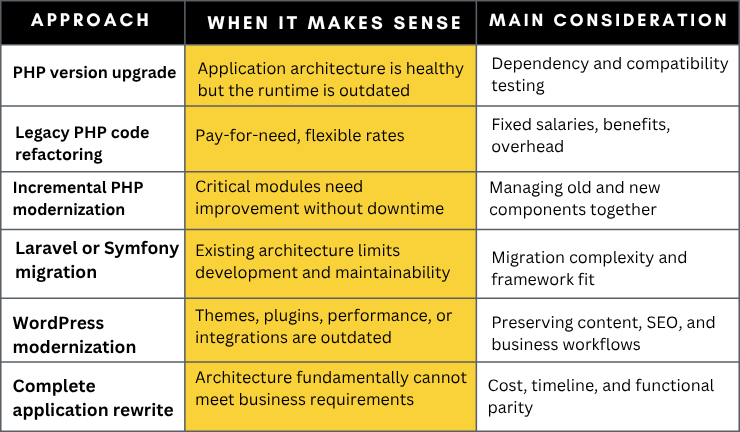
A successful PHP application modernization project should begin with evidence, not assumptions. The objective is to reduce operational risk while delivering measurable improvements in security, performance, and engineering productivity.
Start by identifying the PHP runtime, framework versions, dependencies, database architecture, custom modules, external integrations, and deployment infrastructure. Review code quality, known vulnerabilities, application performance, and test coverage.
The audit should produce a prioritized technical debt register that distinguishes urgent security issues from maintainability improvements and future enhancements. Business-critical functionality should receive special attention because its failure can directly affect revenue and customer operations.
PHP version upgrades are foundational to modernization, but they must be planned around application compatibility. Developers should identify deprecated functions, incompatible libraries, framework requirements, and behavioral changes before changing the production runtime.
According to the official PHP support schedule available in October 2026, PHP 8.2 reaches the end of security support on December 31, 2026. PHP 8.3 receives security support until December 31, 2027, while PHP 8.4 and 8.5 have longer published support windows. These dates make PHP version planning particularly important for applications entering 2027.
The target version should be selected based on supported dependencies, hosting compatibility, framework requirements, and expected maintenance life.
Not every legacy function needs to be rewritten. Prioritize modules responsible for frequent incidents, slow releases, security exposure, or recurring maintenance costs.
Refactoring can involve extracting business logic from presentation code, eliminating duplicated functionality, improving dependency management with Composer, introducing dependency injection, and separating tightly coupled components. Automated regression tests should protect existing business behavior throughout the process.
Legacy PHP performance problems often originate in database access patterns, inefficient queries, excessive coupling, and poorly managed background processes rather than PHP execution alone.
Review database indexes, query plans, transaction handling, caching, connection management, and data integrity. Introduce APIs or service boundaries where they solve a genuine integration or scalability problem. Avoid adding microservices simply because they appear more modern.
A modernized PHP application should support repeatable builds, automated testing, dependency vulnerability checks, and controlled deployments. Tools such as PHPUnit, PHPStan, Composer audit, and suitable application security scanners can help identify problems before they reach production.
For business-critical systems, add integration tests for payment processing, authentication, order management, customer data access, and external APIs. Deploy changes through staging environments with backups, monitoring, and documented rollback procedures.
Once the application has reliable APIs, clear business logic, secure access controls, and sufficient observability, AI features can be introduced more safely.
Start with narrow use cases such as document classification, support-ticket summarization, knowledge retrieval, or internal reporting. Define which data AI systems may access, which actions require approval, and how outputs will be evaluated.
AI integration should be treated as an engineering capability, not simply another API call.
For many businesses, WordPress is no longer just a publishing platform. It supports lead generation, ecommerce, customer portals, membership systems, marketing automation, and integrations with enterprise applications.
That creates a different modernization challenge. A WordPress website may contain years of content, custom PHP functionality, SEO authority, customer records, and revenue-generating workflows. Rebuilding it without understanding those dependencies can disrupt more than its visual design.
WordPress modernization should begin with a compatibility matrix covering the WordPress version, PHP runtime, active plugins, custom themes, and hosting infrastructure. Changes should be tested in a staging environment before production deployment.
WordPress recommends PHP 8.3 or greater, while maintaining compatibility with some older PHP environments. Importantly, WordPress compatibility does not mean an outdated PHP version still receives upstream security updates.
Businesses should treat the WordPress core, plugins, themes, and PHP runtime as one application ecosystem rather than independent components.
Installing another plugin is not always the best solution to a new business requirement. When multiple plugins duplicate functionality, create conflicts, or depend on unsupported vendors, custom WordPress development may provide better long-term control.
Experienced WordPress developers can consolidate functionality, build custom plugins, implement secure APIs, and eliminate unnecessary dependencies. The decision should be based on maintenance costs, security, performance, and business requirements rather than a blanket preference for custom code.
WordPress performance modernization should examine database queries, caching, image delivery, third-party scripts, plugin execution, and server configuration.
For lead-generation websites, performance testing should cover landing pages, forms, mobile navigation, and tracking scripts. For WooCommerce, developers should also examine product searches, cart behavior, checkout processes, and integrations with payment and inventory systems.
Performance improvements should be measured against baseline metrics such as Core Web Vitals, server response times, application errors, and conversion rates.
A WordPress modernization project can damage organic visibility if developers change URL structures, remove valuable content, mishandle redirects, or alter canonical tags without a migration plan.
Before deployment, document existing URLs, metadata, structured data, internal links, redirects, and indexing rules. Validate the staging environment and monitor search performance after release.
The objective is to improve technical performance and maintainability while preserving the search visibility the business has already earned.
AI can accelerate parts of legacy application modernization, but it does not eliminate the need for architecture decisions, security controls, testing, or experienced developers.
The most useful approach is to distinguish between using AI to modernize the application and adding AI capabilities to the modernized application.
AI coding tools can help developers explain unfamiliar functions, identify duplicated logic, propose refactoring approaches, generate tests, and document complex workflows.
However, generated code must be validated against actual business requirements. AI cannot reliably infer every undocumented dependency, production exception, or customer-specific rule from a limited code sample. Senior PHP developers remain responsible for reviewing security, correctness, performance, and compatibility.
Businesses can introduce semantic search, conversational support, content recommendations, and AI-assisted knowledge retrieval into existing WordPress applications.
A secure implementation should retrieve information from approved sources, respect user permissions, distinguish published content from confidential records, and provide a reliable fallback when AI cannot answer.
For organizations using WordPress as a customer portal or knowledge platform, this can create value without requiring a complete CMS replacement.
WordPress is evolving toward more structured AI integration. Its Abilities API and related developer capabilities provide ways to expose application functionality through defined interfaces.
This creates opportunities for AI-assisted content workflows, site management, and integrations, provided that permissions and execution controls are designed carefully.
Businesses should avoid giving AI agents unrestricted administrator access. Instead, developers should define narrowly scoped operations, validate inputs, enforce authorization, log actions, and require approval for high-impact changes.
Modern Laravel applications can integrate AI capabilities directly into PHP-based systems. Laravel 13 includes a first-party AI SDK supporting capabilities such as agents, tool calling, embeddings, and vector-store integrations. Laravel 13 requires PHP 8.3 or later.
For companies already invested in PHP and Laravel, this creates an opportunity to build AI-powered customer portals, document workflows, internal assistants, and business applications without automatically introducing a separate Python backend.
Python remains useful for specialized machine learning workloads, data science, and AI services. A hybrid architecture can connect PHP business applications to Python services when that separation offers a measurable engineering advantage.
There is no reliable fixed price for PHP application modernization because two applications with the same number of screens can have entirely different architectural complexity, integrations, security requirements, and business dependencies.
A small WordPress website with a few custom plugins may require a limited upgrade and refactoring project. A decade-old PHP application supporting customer transactions, financial workflows, and third-party integrations may require a multi-phase modernization program.
The major cost drivers include:
A useful modernization business case should compare the investment against the ongoing cost of incidents, maintenance effort, delayed features, security exposure, and infrastructure inefficiencies.
For example, if a development team spends 160 hours per month maintaining legacy functionality and targeted modernization reduces that to 100 hours, the business recovers 60 engineering hours per month. At a hypothetical blended cost of $75 per hour, that represents $4,500 in monthly engineering capacity, or $54,000 annually, before accounting for the modernization investment.
This is an illustrative calculation, not a promised saving. Actual ROI should be measured against the organization’s own baseline.
The biggest modernization mistake is treating every technical problem as equally urgent. A business should not spend months redesigning low-risk modules while critical authentication, payment, or customer-data components remain exposed.
Use a risk-based modernization backlog.
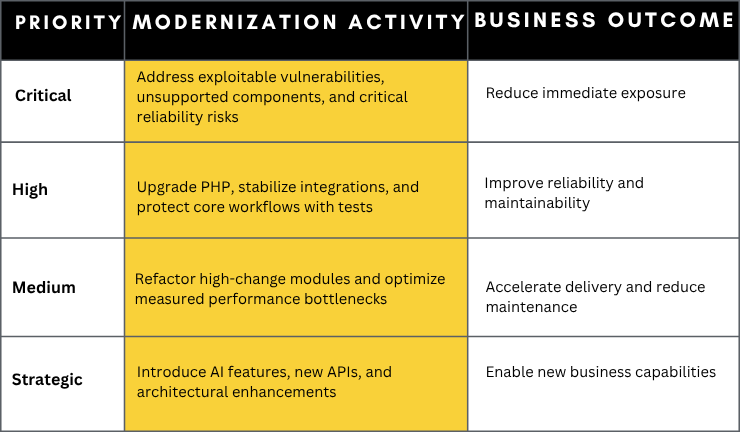
The sequence should reflect actual risk and business impact. A high-revenue checkout issue may deserve attention before a broader framework migration, while an unsupported runtime exposed to the internet may require immediate mitigation.
AI coding assistants can generate PHP functions, WordPress plugins, database queries, and Laravel components. They cannot independently guarantee that those changes preserve business rules, meet security requirements, or remain maintainable under production conditions.
Legacy PHP modernization requires engineers who can understand existing code, identify hidden dependencies, evaluate migration trade-offs, and deliver changes without disrupting critical workflows.
When businesses hire PHP developers for modernization, they should evaluate more than syntax knowledge. Experience with PHP 8, Composer, Laravel or Symfony, SQL optimization, API integration, automated testing, security, and production troubleshooting is particularly relevant.
For WordPress modernization, developers should understand WordPress hooks, custom plugin development, theme architecture, REST APIs, WooCommerce integrations, performance optimization, and safe deployment practices.
The value of an experienced PHP developer in 2027 is not how quickly they can write code. It is how reliably they can change an existing business-critical system without breaking it.
ISHIR helps businesses address legacy application challenges through PHP development, application modernization, WordPress engineering, and AI integration.
ISHIR can help assess outdated PHP applications, identify technical debt, prioritize security and performance issues, and develop a phased modernization roadmap. The focus is on preserving business-critical functionality while improving the application’s long-term maintainability.
ISHIR can help businesses evaluate and implement practical AI use cases, including intelligent search, workflow automation, AI-powered customer support, and integrations with existing enterprise systems. Security, permissions, and measurable business value should guide each implementation.
The goal is to help organizations extend the useful life of existing technology while preparing their applications for changing business requirements.
ISHIR helps modernize PHP applications, upgrade WordPress platforms, and integrate AI with experienced PHP developers.
Yes. PHP remains a practical technology for web applications, content management, ecommerce, and business platforms. Modern PHP frameworks support structured application development, testing, API integrations, and AI capabilities. The important consideration is whether the application uses supported versions, maintainable architecture, and appropriate security practices.
Modernization is often preferable when the existing application contains valuable business logic and can be improved incrementally. A rewrite may be justified when architectural limitations are fundamental or remediation costs exceed the benefits. A technical assessment should compare both options based on cost, risk, functionality, and business continuity.
Yes. Existing PHP applications can connect to AI services through APIs, integrate Laravel AI capabilities where appropriate, or communicate with specialized Python-based services. The application should have reliable integration boundaries, secure data access, logging, and authorization controls before AI is introduced into critical workflows.
Start by documenting existing URLs, content, redirects, metadata, structured data, and internal links. Modernize the PHP runtime, plugins, themes, and custom functionality in a staging environment while preserving important search signals. Test redirects, indexing rules, and site performance before deployment, then monitor Google Search Console afterward.
Costs depend on application complexity, unsupported dependencies, integrations, security requirements, test coverage, and the scope of modernization. A focused PHP upgrade may require substantially less work than restructuring a large custom application. A technical audit is the most reliable way to estimate scope, timelines, and costs.
Laravel can provide a modern foundation for PHP applications, but migration should be based on technical and business requirements. Some applications benefit from gradually moving modules into Laravel, while others can be improved through targeted refactoring without a framework migration. Existing business rules and integrations must be protected throughout the process.
Common indicators include unsupported PHP versions, outdated plugins, frequent compatibility problems, slow performance, recurring security issues, and difficulty implementing new features. Businesses should also consider modernization when their WordPress platform cannot integrate reliably with CRM, ecommerce, analytics, or AI systems.
Look for developers experienced in legacy code analysis, modern PHP, database optimization, security, automated testing, and production deployments. For WordPress projects, evaluate custom plugin development, theme architecture, performance engineering, and integration experience. The ability to protect existing business functionality is more important than familiarity with a particular framework alone.
Your existing PHP or WordPress application may still be generating revenue, supporting customers, and delivering business value. That is a reason to modernize it carefully, not a reason to ignore its growing limitations or replace it without a clear business case.
The companies that approach 2027 with a structured modernization strategy can address security exposure, reduce unnecessary maintenance, improve engineering productivity, and introduce AI capabilities while preserving their existing technology investments.
The question is not whether PHP is old. The question is whether your application architecture is preventing your business from moving forward.
The post Is Your Legacy PHP Application Becoming a Business Risk? How to Modernize It in 2027 appeared first on ISHIR | Custom AI Software Development Dallas Fort-Worth Texas.


